
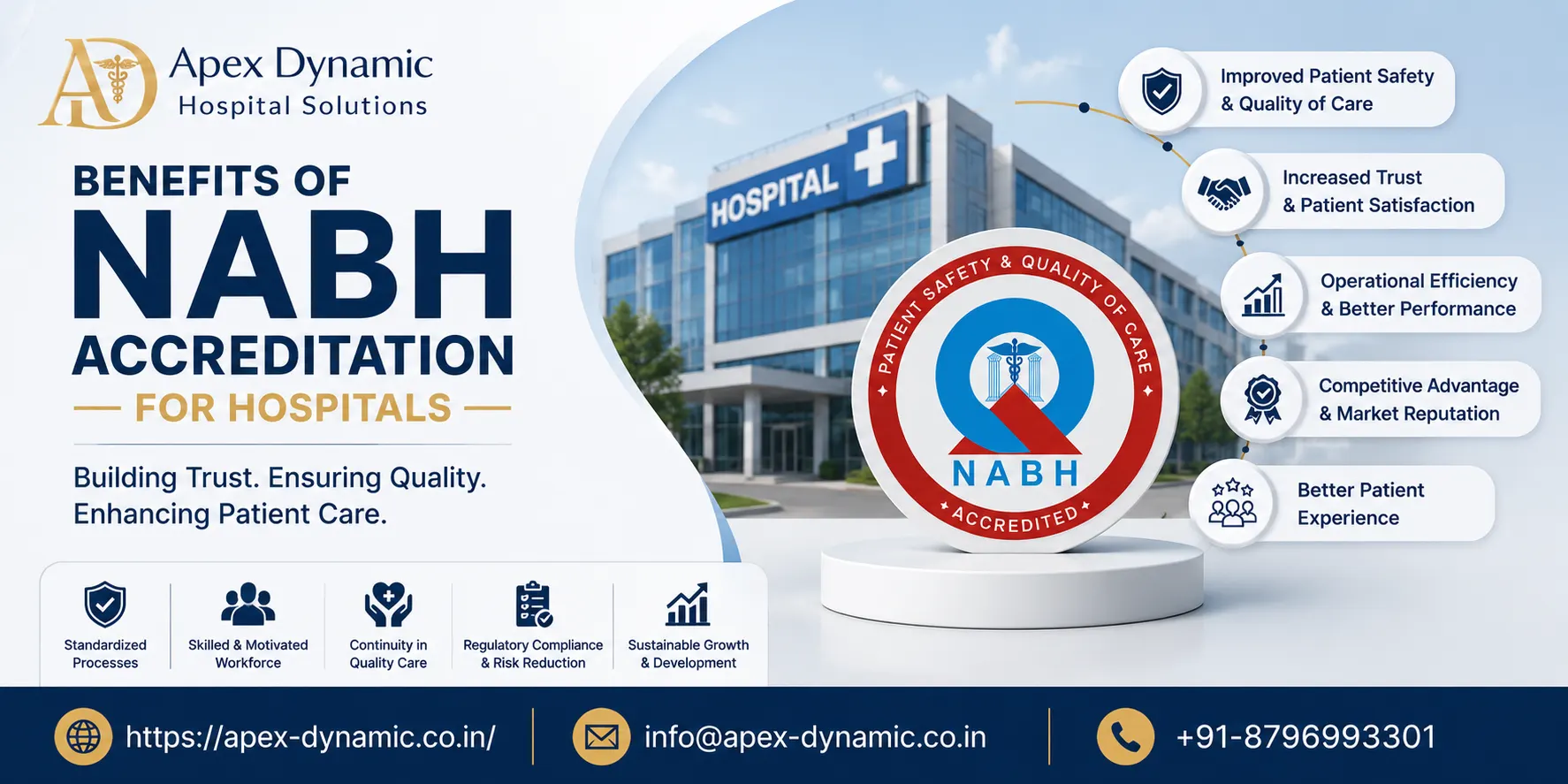
Benefits of NABH Accreditation for Hospitals
What makes one hospital consistently deliver safer, more organized, and patient-focused healthcare than another? While skilled doctors and modern medical equipment are essential, the real difference often lies in standardized systems that ensure quality in every department.
This is where NABH Hospital Accreditation plays an important role. Accreditation is much more than a certificate displayed at the hospital entrance. It creates a culture of continuous improvement where patient safety, clinical excellence, staff accountability, and operational efficiency become part of everyday healthcare delivery.
Hospitals across India are increasingly adopting structured quality frameworks because they help improve treatment outcomes while building confidence among patients, healthcare professionals, and regulatory authorities. Whether it is a multispeciality hospital, specialty centre, clinic, or AYUSH facility, the benefits of the NABH Accreditation Process extend far beyond regulatory compliance and contribute to long-term organizational growth.
Why is NABH Accreditation considered an important milestone for hospitals?
Healthcare today is more complex than ever before. Hospitals manage thousands of clinical decisions, patient interactions, emergency situations, laboratory investigations, pharmacy operations, infection control activities, and administrative responsibilities every single day. Without standardized systems, maintaining consistency becomes extremely difficult.
The Quality Management System for Hospitals introduced through NABH standards helps organizations establish clear responsibilities, documented procedures, measurable quality indicators, and continuous monitoring. Rather than depending on individual practices, hospitals develop organization-wide systems that improve coordination between departments and reduce the possibility of errors.
Many healthcare organizations begin their quality journey with guidance from a NABH Accreditation Consultant, Healthcare Quality Management Consultant, or Hospital Compliance Consultant to understand how structured quality systems can improve overall hospital performance.
How does NABH Accreditation improve patient safety?
Patient safety is one of the strongest benefits of accreditation.
NABH standards encourage hospitals to implement systematic procedures for patient identification, medication safety, infection prevention, emergency preparedness, surgical safety, incident reporting, and clinical documentation. Every process is designed to reduce avoidable risks while ensuring patients receive consistent care throughout their treatment journey.
Instead of relying on individual experience alone, hospitals establish standardized protocols that every department follows. This creates greater coordination between doctors, nurses, pharmacists, laboratory teams, and administrative staff.
Healthcare organizations implementing NABH Accreditation Services often observe improvements in communication, documentation accuracy, and patient care continuity because every activity follows approved procedures.
Why does accreditation strengthen healthcare quality?
Quality healthcare is achieved through continuous improvement rather than isolated efforts.
The NABH Accreditation Process encourages hospitals to regularly monitor quality indicators, review clinical outcomes, evaluate patient feedback, investigate incidents, and implement corrective actions whenever improvement opportunities are identified.
Instead of waiting for problems to occur, healthcare organizations proactively monitor performance across departments. This approach creates a culture where quality becomes part of routine operations rather than a periodic compliance exercise.
Many hospitals seek support through Healthcare Consultancy Services or a Healthcare Quality Consultant while implementing these quality improvement systems to ensure that practical improvements become sustainable over time.
How does NABH Accreditation improve hospital management?
Effective hospital management depends on clearly defined processes.
Accreditation promotes organized documentation, better communication between departments, improved record management, structured decision-making, and clearly assigned responsibilities. Every department understands its role within the larger healthcare system.
Hospital administrators benefit from standardized reporting mechanisms, quality reviews, performance monitoring, and management meetings that support informed decision-making. Departments become more accountable because activities are documented and periodically evaluated.
Organizations working with a NABH Consultant India, Hospital Accreditation Services, or Hospital Accreditation Consultancy Services often focus on strengthening management systems alongside clinical improvements.
Why is documentation one of the biggest advantages of accreditation?
Proper documentation improves consistency throughout the hospital.
Policies, Standard Operating Procedures (SOPs), patient records, infection control manuals, emergency response plans, biomedical waste procedures, equipment maintenance schedules, quality indicators, and administrative records help create uniform working practices across departments.
Documentation ensures that important clinical and operational activities continue smoothly regardless of staff changes or workload variations.
Many hospitals use NABH Documentation Services, NABH SOP Consultant, or NABH Documentation and Training Services to establish documentation systems that are practical, organized, and aligned with healthcare quality standards.
Well-maintained documentation also supports transparency and continuous quality monitoring.
How does staff training benefit hospitals after accreditation?
Healthcare quality depends largely on the knowledge and awareness of healthcare professionals.
NABH encourages regular staff education on infection prevention, patient safety, biomedical waste management, emergency preparedness, medication management, documentation standards, communication skills, and quality improvement initiatives.
Through structured NABH Training for Hospitals and NABH Training Services, employees understand not only what they should do but also why each process is important.
Continuous learning improves teamwork, reduces operational confusion, strengthens compliance, and creates greater confidence among healthcare professionals working across different departments.
Can accreditation improve patient confidence?
Patients today actively seek healthcare organizations that demonstrate commitment to quality and safety.
Hospitals operating under standardized quality systems often provide better communication, organized treatment pathways, transparent documentation, improved patient education, and more structured complaint handling mechanisms.
When patients experience consistent processes throughout registration, consultation, investigation, treatment, discharge, and follow-up, their overall confidence naturally improves.
Accreditation therefore contributes to stronger patient satisfaction while encouraging hospitals to continuously improve healthcare delivery based on patient feedback.
Why are internal audits valuable for hospitals?
Continuous evaluation helps organizations identify improvement opportunities before they become major operational issues.
Internal audits review documentation, departmental compliance, patient safety measures, equipment maintenance, infection control practices, quality indicators, and implementation of hospital policies.
Many healthcare organizations also perform NABH Mock Audit Services to prepare staff for external assessments while identifying areas requiring corrective action.
Rather than viewing audits as inspections, accredited hospitals use them as learning opportunities that strengthen healthcare quality over time.
How does accreditation support smaller hospitals and clinics?
Quality healthcare is not limited to large hospitals.
Smaller healthcare organizations can also implement structured quality systems appropriate to their scale. NABH Entry Level Accreditation, NABH Accreditation for Clinics, NABH Accreditation for AYUSH Centres, and guidance from a NABH Consultant for Small Hospitals allow healthcare facilities to improve patient safety, documentation, infection control, and operational efficiency without unnecessary complexity.
Entry-level accreditation often serves as a practical foundation for organizations planning long-term quality improvement.
Does NABH Accreditation benefit multispeciality hospitals differently?
Large hospitals usually manage multiple departments simultaneously, including emergency medicine, intensive care, surgery, diagnostics, pharmacy, imaging, rehabilitation, laboratory services, and outpatient care.
The standardized framework developed through NABH Accreditation for Multispeciality Hospital helps coordinate activities across departments while improving communication, documentation, patient flow, clinical governance, and management oversight.
Hospitals pursuing NABH Full Accreditation Consultant guidance generally strengthen organization-wide quality systems that support both patient care and administrative efficiency.
How does NABL Accreditation complement hospital quality?
Many hospitals also operate diagnostic laboratories where quality assurance is equally important.
Implementation involving NABL Accreditation Consultant, NABL Consultant India, NABL Laboratory Accreditation, NABL Documentation Services, NABL Compliance Consultant, Diagnostic Lab Accreditation, NABL Audit Consultant, NABL Quality System Implementation, and NABL Accreditation for Diagnostic Labs focuses on laboratory quality, testing accuracy, documentation, equipment calibration, and technical competence.
Together, NABH and NABL contribute to stronger healthcare delivery by improving both clinical services and diagnostic reliability.
What role does accreditation play in future empanelment opportunities?
Healthcare organizations planning government healthcare participation often strengthen quality systems before pursuing empanelment.
Processes associated with CGHS Empanelment Consultant, CGHS Empanelment Services, CGHS Hospital Empanelment, CGHS Approval Process, ECHS Empanelment Consultant, ECHS Hospital Registration, Healthcare Empanelment Services, Government Hospital Empanelment, CGHS Empanelment Consultancy Services, and ECHS Empanelment Consultant may require separate eligibility criteria depending on applicable government policies.
Hospitals frequently consider accreditation as an important step toward building stronger compliance systems before expanding into additional healthcare programs.
How do experienced consultants support quality implementation?
Healthcare organizations located in NABH Accreditation Delhi NCR, working with a NABH Consultant Delhi, NABH Consultant Gurgaon, NABH Consultant Noida, NABH Consultant Ghaziabad, NABL Consultant Delhi NCR, Healthcare Consultant Delhi NCR, Hospital Accreditation Consultant Near Me, NABH Accreditation Consultant Delhi NCR, or a Best NABH Consultant in India often seek structured guidance to understand documentation requirements, staff training, internal audits, quality monitoring, and implementation planning.
The objective remains the same across all healthcare organizations—developing sustainable quality systems that continue improving patient care long after accreditation is achieved.
Frequently Asked Questions
Need Professional Guidance for NABH Accreditation?
Whether your healthcare organization is planning for NABH Entry Level Accreditation, Full NABH Accreditation, NABL Accreditation, Hospital Documentation, Quality Management System Implementation, Mock Audits, or Healthcare Compliance, Apex Dynamic Hospital Solutions provides complete consultancy, documentation, implementation, training, and assessment support for healthcare organizations across India.